.png)


Updated: Jul 4

Your VW is losing coolant steadily. The reservoir drops. The warning light flickers. But there is no puddle on the floor and no wet patch under the bonnet. This is not a mystery. It is a specific failure pattern, and it points inward, not outward. Volkswagen repair specialists at Gran Turismo Auto Repairing LLC in Al Quoz, Dubai see this on Passat, Tiguan, Jetta, and Touareg models regularly. The fluid is not disappearing. It is being consumed or evaporating through paths you cannot see from the outside.
Why Volkswagen Coolant Disappears With No External Leak
Internal Combustion Chamber Intrusion Is the Core Mechanism
An external coolant leak leaves a trail. A puddle, a stain, a wet hose, a damp joint. When none of these appear, the fluid is entering the combustion chamber and burning off during the engine cycle. This is internal intrusion, not an external seal failure. On VW petrol and diesel engines, three components are most responsible: the head gasket, the EGR cooler, and the coolant reservoir assembly.
The volkswagen coolant warning light typically activates once the level drops below the minimum mark. By that point, the engine has been running low for some time. VW Group's volkswagen g13 coolant specification is a purple OAT-type fluid. If the reservoir shows a diluted pink or clear tone, coolant has been topped up with plain water somewhere along the line, which accelerates corrosion in the cooling circuit and compounds the root failure.
What internal coolant loss looks like in practice
Reservoir level drops every few days with no external puddle or drip
White or grey smoke from the exhaust at startup, especially on cold mornings
Volkswagen coolant warning light activates repeatedly after topping up
Sweet smell at the exhaust tip or near the engine bay
Coolant colour is diluted, pale, or discoloured compared to factory VW G13 purple
Engine temperature reads slightly higher than normal on certain cycles
Head Gasket Micro-Fractures: The Hidden Combustion Burn

Small Cracks Burn Coolant Without Producing a Visible External Trace
Head gasket failures are not always catastrophic. On many VW 1.4 TSI, 1.8 TSI, 2.0 TDI, and 3.0 TDI engines, the gasket develops micro-fractures rather than full breaches. These cracks sit between the coolant gallery and the combustion chamber. Coolant seeps in during the intake stroke and burns off during combustion. The result is a minor but constant fluid loss that produces no puddle, no external wetness, and no immediate overheating.
What you get is white exhaust vapour, particularly on startup when coolant has pooled slightly overnight. As the engine warms, combustion pressure drives exhaust gases back into the coolant circuit. This is why a block test is the correct first diagnostic step. The ODIS system used at Gran Turismo Auto Repairing LLC reads coolant temperature deviation and flags abnormal combustion signatures before they escalate into a full head gasket replacement job.
Block Test Confirms Combustion Gas in the Coolant Circuit
A chemical block test is the fastest way to confirm head gasket intrusion. The tester draws vapour from the coolant reservoir through a yellow chemical fluid. If combustion gases are present, the fluid turns blue-green. This confirms internal leakage before the engine produces visible symptoms or throws a fault code. Gran Turismo applies this test as part of volkswagen service diagnostics whenever unexplained coolant loss is reported on a volkswagen passat, vw jetta, or volkswagen touareg in Dubai.
Head gasket micro-fracture: key diagnostic indicators
White exhaust smoke on cold startup that clears after a few minutes of running
Sweet smell at the exhaust, indicating coolant entering the combustion chamber
Block test turns blue-green, confirming combustion gas contamination of coolant
ODIS fault log shows coolant temperature deviation or misfire under load
Coolant reservoir drops consistently without any external drip or wet joint
Oil cap may show a light milky residue if the breach is larger than a micro-fracture
Cracked Plastic Reservoir Components: Invisible Evaporation Loss
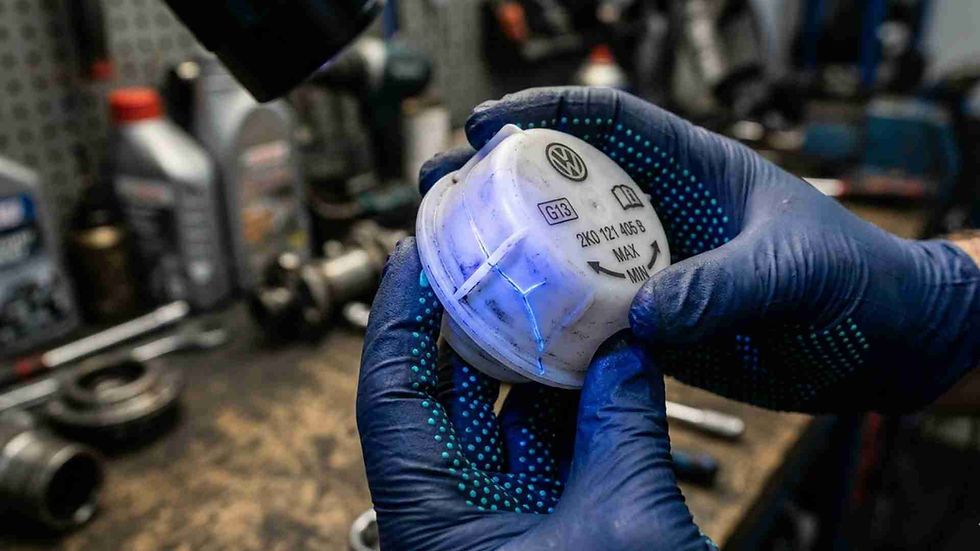
VW Coolant Tank Lids and Reservoir Tops Develop Hairline Cracks Over Time
The volkswagen passat coolant tank and the reservoir caps on VW Golf, Tiguan, and Touareg models are made from polypropylene. In Dubai's heat cycle, plastic components expand and contract daily. Over time, the reservoir cap seal degrades, and hairline cracks form in the tank top or along the neck seam. These cracks do not produce drips. Instead, coolant evaporates slowly under pressure, escaping as vapour rather than liquid.
This type of loss is easiest to detect by pressurising the cooling system with a coolant pressure tester. If the system cannot hold pressure, the location of the leak reveals itself. A cracked cap fails immediately under pressure testing. A cracked tank top shows moisture and weeping. This is a low-cost repair when caught early. Left untreated on a volkswagen tiguan coolant circuit or a coolant leak vw golf situation, the eventual consequence is air entering the system and localised overheating.
Plastic reservoir failure: what the workshop checks
Reservoir cap seal inspected for cracks, softening, or deformation
Tank top and neck examined under UV light for hairline fracture lines
Pressure test applied to isolate evaporative loss from the reservoir assembly
VW G13 coolant colour checked for dilution or discolouration
VW Touareg and Tiguan reservoir mounting brackets checked for stress cracks
Cap pressure rating verified against VW specification for the model
EGR Cooler Failure: Coolant Entering the Intake With No External Trace

Failed EGR Coolers Send Coolant Vapour Into the Intake Manifold
VW diesel engines, particularly the 2.0 TDI found in Passat, Golf, and Tiguan models, use an EGR cooler that circulates coolant to reduce recirculated exhaust gas temperature. When the EGR cooler develops an internal crack or tube failure, coolant passes directly into the exhaust gas stream and enters the intake manifold as vapour. There is no external leak. The fluid routes through the engine and is consumed or expelled through the exhaust.
A vw golf coolant leak diagnosis that returns no external source should always include the EGR cooler as a suspect on diesel variants. The coolant loss is real, but it exits through an internal path. ODIS will often log an EGR efficiency fault before the coolant loss becomes severe. Gran Turismo's technicians remove the intake tract and inspect for coolant residue in the intake manifold and throttle body as part of this specific diagnostic check.
On vw touareg coolant systems with the 3.0 TDI V6, EGR cooler failure also produces white smoke under acceleration and a noticeable drop in coolant level across a single week of normal driving. The repair requires EGR cooler replacement, intake manifold cleaning, and a full cooling system flush.
EGR cooler failure: workshop diagnostic steps
ODIS scan checked for EGR efficiency faults and intake pressure deviation
Intake manifold removed and inspected for coolant staining or residue
EGR cooler pressure tested off the vehicle to confirm internal tube failure
Throttle body cleaned if coolant has tracked into the intake circuit
Full cooling system flush completed after EGR cooler replacement
VW G13 coolant refilled and bled according to model-specific procedure
Volkswagen Repair in Dubai: Al Quoz Workshop Serving All VW Models

Gran Turismo Auto Repairing LLC operates from Industrial Area No. 4, Street No. 26, Al Quoz, Dubai. The workshop is accessible from Sheikh Zayed Road and Al Khail Road, making it straightforward to reach from Business Bay, DIFC, Jumeirah, Dubai Marina, and Barsha Heights.
Volkswagen repair dubai work at Gran Turismo covers all VW Group models including Passat, Golf, Jetta, Tiguan, Touareg, and Polo. The workshop uses ODIS diagnostic software for all VW and Audi Group vehicles, the same platform used at authorised dealerships. Booking can be made by phone or WhatsApp.
Frequently Asked Questions
Why is my Volkswagen losing coolant with no visible leak anywhere?
When coolant disappears without a puddle or external drip, the fluid is most likely entering the combustion chamber through a micro-fractured head gasket, escaping as vapour through a cracked reservoir cap or tank top, or routing through a failed EGR cooler into the intake manifold. A chemical block test and a cooling system pressure test are the two fastest ways to locate the source during a proper volkswagen repair diagnostic.
What does the Volkswagen coolant warning light mean when there is no visible leak?
The volkswagen coolant warning light activates when the fluid level drops below the sensor threshold. If there is no puddle under the car and no wet hose visible, the system is losing fluid internally through combustion or evaporation. Topping up and ignoring the light will not fix the underlying fault. The loss will continue and accelerate. Book a diagnostic check before the warning returns a third time.
Is VW G13 coolant required, or can I use a generic coolant in a VW?
VW G13 coolant is the correct specification for most current Volkswagen models. It is a purple OAT-type fluid formulated to protect VW's alloy components and silicone hoses. Using a generic green or blue coolant introduces incompatible inhibitors that can cause corrosion in the cooling circuit and block the small passages in the heater core. Always use VW G13 or a certified G13-compatible product.
How do I know if my VW Golf or Passat has a head gasket problem?
The three clearest signs are: steady coolant level drop with no external leak, white exhaust smoke at startup that clears as the engine warms, and a sweet smell from the exhaust. A block test at a volkswagen repair workshop confirms combustion gas in the coolant circuit within minutes. ODIS diagnostics on the vw golf coolant leak history and coolant temperature log show whether intrusion is ongoing.
Where can I get a Volkswagen coolant diagnostic near me in Dubai?
Gran Turismo Auto Repairing LLC in Al Quoz, Dubai provides full volkswagen repair diagnostics including block testing, cooling system pressure checks, EGR cooler inspection, and ODIS fault log analysis for all VW models. The workshop serves clients from Business Bay, Jumeirah, DIFC, Dubai Marina, and surrounding areas. Call +971 4 388 1544 or WhatsApp +971 50 801 1743 to schedule.
Can an EGR cooler failure cause coolant loss on a VW Tiguan or Touareg?
Yes. On VW diesel engines, an internally cracked EGR cooler sends coolant through the exhaust gas stream and into the intake manifold. The fluid is consumed or expelled through the exhaust, leaving no external trace. This is a confirmed failure pattern on the 2.0 TDI in the Tiguan and the 3.0 TDI in the Touareg. Diagnosis requires intake manifold removal and EGR pressure testing off the vehicle, not just an ODIS scan.
What happens if I ignore Volkswagen coolant loss and keep topping up?
Repeatedly topping up without fixing the root cause dilutes the coolant inhibitor concentration and introduces air into the system. Air pockets cause localised overheating in cylinder head passages, which accelerates gasket damage. On a head gasket micro-fracture, continued operation without a repair turns a moderate job into a full head gasket replacement or, in severe cases, head surface machining. The longer it runs, the more expensive the repair becomes.
VW Losing Coolant? Book a Diagnostic Today Gran Turismo Auto Repairing LLC, Al Quoz, Dubai Call: +971 4 388 1544 | WhatsApp: +971 50 801 1743 |
Contact Gran Turismo Auto Repairing LLC
Business Name: Gran Turismo Auto Repairing LLC
Address: Industrial No 4, Street No 26, Al Quoz, Dubai, UAE
Phone: +971 4 388 1544 | +971 50 801 1743 (WhatsApp)
Email: info@granturismo.ae
Website: https://www.granturismo.ae/
Google Maps: View on Google Maps


.webp)
.png)
Comments